

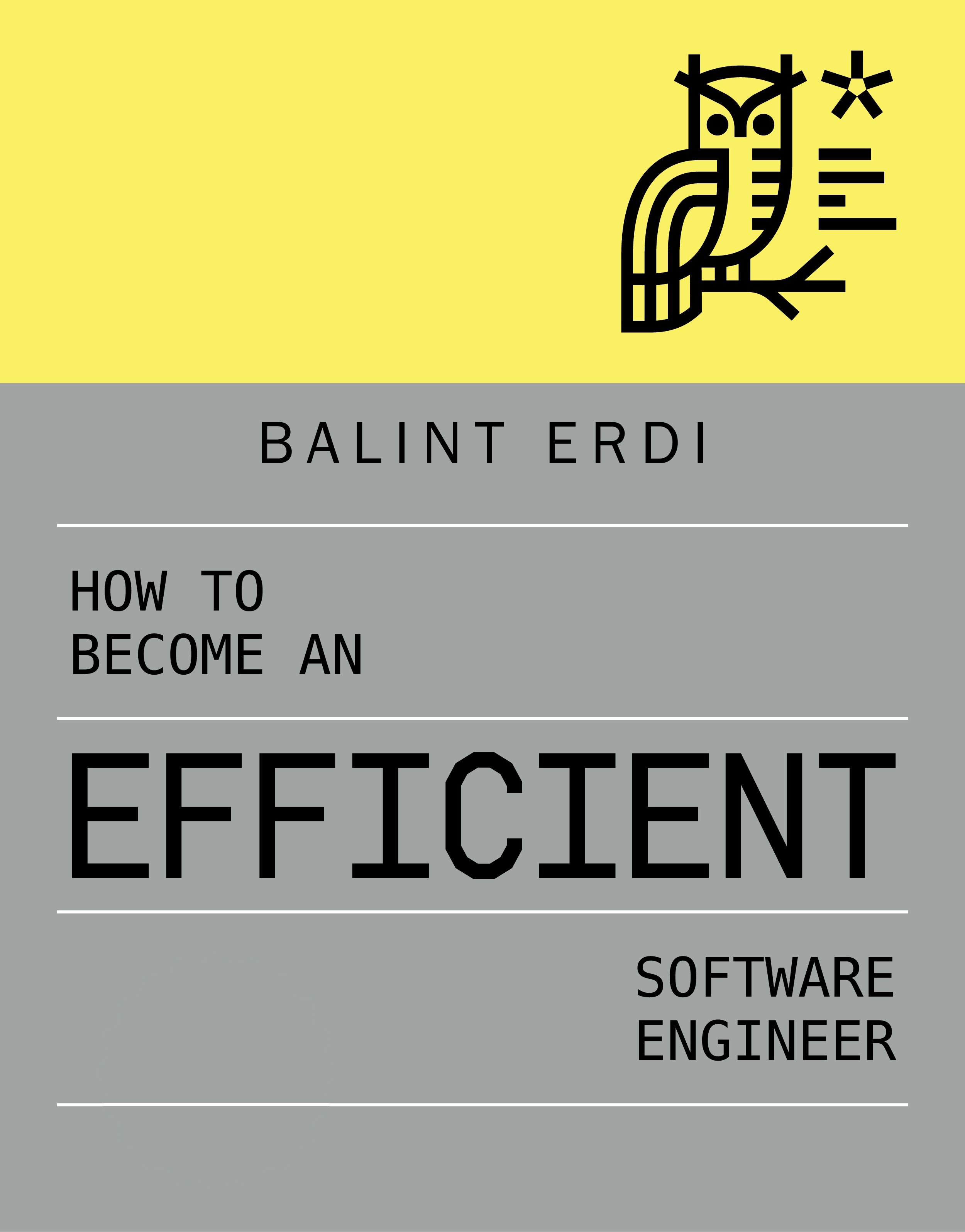
Build the habits and skills that turn you into a solid senior software engineer
There is no hack to becoming a senior engineer overnight, no shortcut to putting in lots of hours of practice to reach that goal. However, as in any discipline, what and how you learn and practice make a huge difference – and this book shows you what to focus on.
About me
Why should you listen to me?
I'm Balint Erdi, a software engineer with 25 years of experience.
After more than a decade of building web back-ends, I discovered Ember.js in 2014. I liked it so much that I started teaching others through various means, eventually writing the most popular book on the framework.
Based on the feedback I received, people found my teaching very efficient and pragmatic. As I worked with developers early in their careers, I saw where they struggled and began to deliberately think about (and then write down) the practices and traits of senior developers.
With this book, I want to repeat the success of the Ember book, but help even more people: if you're a junior software engineer, this book is for you.

Get a glimpse
Download a sample
Skills & Traits
What you need to focus on
Start before you feel ready
Chances are you'll hit a snag when working on the assigned feature, and you might even feel miserable. We've all been there (heck, we're still all there some of the time), but the only way to become better is to start the quest.
Protect your attention & energy
Software engineering can be challenging. What makes it harder still is trying to think in abstract concepts on an average of five hours of sleep. So put your phone away, give sleep its due priority, and take care of your health.
Take breaks, lift weights
Taking breaks might seem like a waste of time, and who has time for working out? Yet, both stepping away from the keyboard regularly and giving your body the physical activity it needs will boost your productivity.
Express yourself clearly
Working in teams requires clear and efficient communication. You could have the best idea on the planet – if you can't explain it to your coworkers, managers (or Claude Code), it's worth nothing.
Level up by learning from others
It's a cliché that our profession is one where lifelong learning is a must. Luckily, there are an infinite number of ways you can do that, and it's up to your preference and possibilities which ones you choose: the crucial bit is to stay curious and take some time to learn new things.
Keep code dumb
As we become more experienced, we tend to write smart code to show our skills. Resist the temptation, and keep writing code that's easy to understand. Your colleagues, your future self and your LLM will thank you.
Master your tools
As a software engineer, you spend a big part of your day in your editor and terminal. Becoming more efficient with them and customizing them to your liking is a force multiplier, so take your time to learn them well.
Become a bugbuster
Reproducing and fixing bugs has always been a superpower. At the same time, debugging is possibly the hardest of a software engineer's many tasks, so having a variety of techniques at your disposal and continuously improving them is a very good idea.
From curiosity to craft
Why I Wrote This Book
I started with no passion whatsoever for my profession, but the more I learned and coded, the more I enjoyed it – a trend that continues to this day.
I also got curious about what skills make a senior software engineer, so I started observing myself and other senior developers to find the common habits and practices. At the same time, as I worked with many juniors, I began to see where they struggled, which skills they lacked, and which areas they didn't focus enough on.
I found myself thinking more and more about high-yield tips, skills, and techniques to help them reach senior status more quickly.
Coupled with my passion for teaching and my propensity for the written word, this led to the idea for this book: a collection of those senior traits that would help engineers early in their career level up faster and enjoy their craft.

What readers say
" This book captures a lot of the advice I give as a technical mentor and have received as a mentee. Learning to manage yourself is a journey that it is helpful to have a blueprint for! "

Jen Weber
Engineering Tech Lead at Healthie
" Balint keeps a balance that many devs, including myself, miss; how to get great leverage from AI tools while staying sharp as an engineer yourself. "
Konrad Kiss
CPO, AI Origo
Frequently Asked Questions
I'm not a complete beginner. Is this book for me?
If you're early in your career, or you have vibe-coded and want to understand more of what you're doing, it is for you. On a scale of 1-10 (where 10 is Linus Torvalds, and 1 is someone fresh out of college/bootcamp), the book is probably a good fit if you're somewhere between 1 and 5.
Can you tell me more about the 1:1 orientation call?
It's a video call tailored to your situation. I'll ask you to fill out a short form beforehand so I can come prepared — whether that means giving you personalized advice on where to focus your professional development, reviewing your project, or answering whatever questions you bring.
All updates for free, forever?
Yep. I believe it's important to be able to send updates to an electronic book. And with best practices of AI-assisted development still forming, I expect to make several updates in the coming years.
What about AI?
AI has changed many aspects of software development, but most of the tenets remain valid. My promise of free updates aims to address that: as AI best practices (and capabilities) change, so will the book.
What if I don't like what I bought?
No problem. You have a 30-day money-back guarantee. I will ask why (so that I can improve), but I'll refund you no matter what.
Do you offer discounts?
I offer PPP (Purchasing Power Parity) pricing for the book (though not for the 1:1 call), meaning the price adjusts based on where you live - because $X means something very different depending on where you are in the world. If you're still not able to afford it, reach out to me, and we'll figure something out.
How can I get an invoice for my purchase (and reclaim EU VAT)?
After the purchase, Gumroad will send you an email with a receipt that has a link to their invoice generator. There, you'll be able to fill out your company details and, if you're an EU entity, reclaim the EU VAT.
I still have a question. How can I reach you?
Happy to help! Please email me with your question.